ACS Heating and Air, Air Conditioning Specialist Inc., is a full-service HVAC company serving Milledgeville, Covington, and the surrounding Georgia communities. Where most outfits reach for refrigerant or quote a new unit, our diagnostic approach starts with airflow and drainage first, because that’s where the real trouble almost always hides.
Between pollen thick enough to clog a screen in a couple hours and the aging ductwork buried in those older Covington homes, your system is usually working harder than it should. At Air Conditioning Specialist Inc., we’ve spent decades pulling apart units that were never actually broken. They were choking.
Hidden Airflow Restrictions and Component Failures
A restricted filter or a blocked return grille is the single most common reason a healthy system starts acting sick. When air can’t move, static pressure climbs, and everything downstream suffers. Airflow drives everything. According to ASHRAE Standard 62.2, residential systems are designed around specific airflow rates, when static pressure rises beyond design limits, the whole system operates outside its rated envelope.
Had a call over on West Hancock a while back. Homeowner had paid two separate outfits for “refrigerant charges” across one summer, and the house still wouldn’t cool. Nobody looked at the return.
Turned out a return duct behind a kitchen cabinet had collapsed on itself, and the system was basically breathing through a straw. Fresh duct, problem gone. She’d spent hundreds chasing a charge that was fine the whole time.
High-MERV filters are a big culprit in older homes. People read that a higher number is healthier, so they cram a higher-rated MERV filter into a return that was sized for something far looser. Going higher is fine if your blower can handle the static pressure, something MERV ratings explained for different home types can help clarify, which in a lot of older Milledgeville homes is a coin flip.
An 4-inch media cabinet gives you more surface area, so you can push filtration up without strangling the blower. But a tight 1-inch slot with a high-MERV filter stuffed in it? The filter bows inward and air bypasses around the edges. Useless, and expensive-useless at that.
Air Filter Comparison: 1-Inch vs. 4-Inch Media Cabinet
| Feature | 1-Inch Flat Filter | 4-Inch Media Cabinet |
|---|---|---|
| MERV range typically available | MERV 1 to 13 | MERV 8 to 16 |
| Surface area | Low | High (roughly 4 to 5× more) |
| Static pressure impact | High at MERV 11+ | Low even at MERV 13 |
| Change frequency | Every 1 to 3 months | Every 6 to 12 months |
| Recommended use case | New, high-CFM systems | Older homes with restrictive returns |
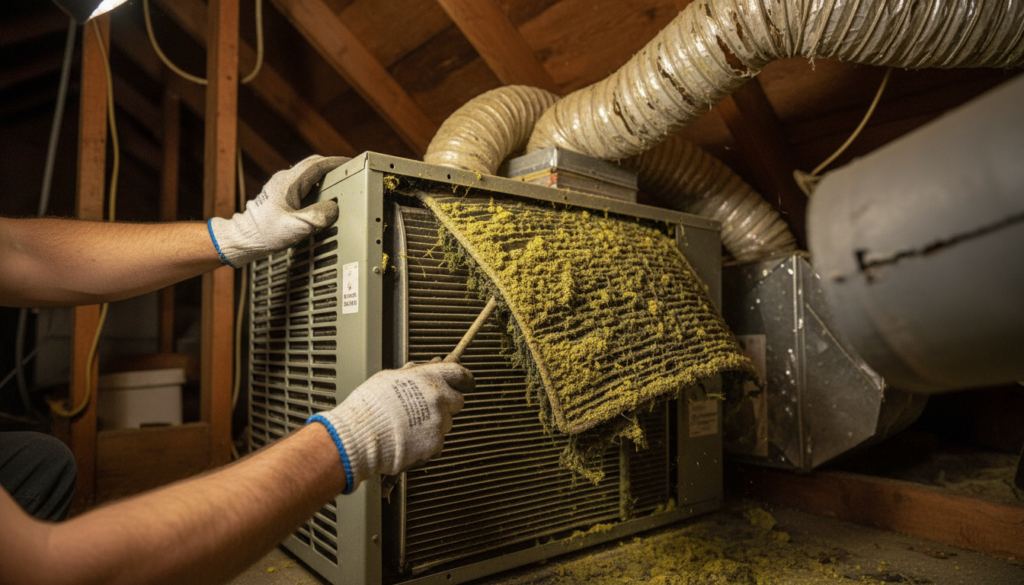
When airflow stays restricted long enough, the coil ices. And a frozen coil is where the bills climb fast, because now you’re into deep cleaning or worse.
Why Your Coil Freezes When Airflow Drops
A coil freezes because low airflow lets it get colder than it’s supposed to, and then moisture on it turns to ice. Here’s how it actually plays out. The filter chokes the blower.
The blower slows down. The coil gets too cold. Cold coil plus weak airflow equals frost, then a solid block. You already know what happens next: no cooling, and a puddle when it finally thaws.
The coil was a solid brick of ice by the time we got to one house out toward Gray last July. Homeowner swore the system had never been touched wrong. The filter hadn’t moved since, let’s just say, months back. That’s the whole story right there.
I know, telling folks to regularly replace their air filter sounds like the classic technician lecture. But we’ve watched a neglected three-dollar filter cause thousands in compressor damage.
The Return Air Problem Nobody Checks
Return air temperature drop tells you whether a system is actually breathing, and almost nobody measures it. It honestly wears me out how many perfectly good units get replaced early because no one put a thermometer on the return and the supply.
You see these systems out in the heat, straining against a vacuum they built for themselves. It’s like watching a car run with the parking brake on while the owner complains about gas mileage.
That’s not a repair problem. That’s a diagnosis problem, and it’s on us in this trade to check it before we sell anybody a new box.
Noisy Fan or Failing Motor?
A noisy fan usually means a bearing or a balance issue, while a failing motor gives you heat, hesitation on startup, or a hum that never turns into spin. You can tell a lot without a service call.
A rattle that changes with fan speed is often debris or a loose blade. A grinding that gets worse is bearings on the way out.
A homeowner told me last summer it sounded like “a dryer full of marbles.” She wasn’t wrong. That’s a failing blower wheel, more or less exactly.
Electrical Warning Signs You Should Never Ignore
If you smell burning electrical components, stop touching the thermostat and cut power at the breaker. Now.
Breaker trips on startup? Don’t reset it twice to see what happens. That’s a compressor pulling locked rotor amps, and every reset stresses the winding. Same with any hot, sharp smell near the air handler or the disconnect. Capacitors hold a charge even after the power’s off. This isn’t a YouTube afternoon.
Chattering relays are their own warning. A burned-out contactor is a straightforward swap on its own. But ignore that chattering sound long enough and it usually drags the whole start kit down with it.
Why Refrigerant Top-Offs Are a Myth
A refrigerant “top-off” is a red flag, not a fix, because a sealed system doesn’t consume refrigerant. If you’re low, you have a leak, period. Adding refrigerant without finding the leak is throwing money at a problem that comes right back, and venting refrigerant is a code violation on top of it.
Demand a leak search instead. The signs your air conditioner is low on refrigerant are usually detectable well before the leak becomes expensive.
If you live out by Lake Sinclair, there’s another wrinkle. (The humid, salty-feeling air near the water eats outdoor coils faster than most people realize, no matter how often you hose them off.) Refrigerant leaks at the coil show up earlier on those lakeside units. That’s not superstition, that’s corrosion doing what corrosion does.
Duct Tape and Other Bad Ideas
Duct tape on ductwork fails, and the irony of the name is an old joke in this trade. It dries out and peels off within weeks because it was never made for the temperature swings inside a supply run.
If you’ve got leaking supply ducts, the fix is mastic or a proper foil tape rated for the job. Poor duct sealing is also one of the clearest signs you need ductwork cleaning or a full inspection while you’re in there.
We’ve pulled baby gates, shoe racks, and once a full laundry hamper off return grilles. People treat the grille like furniture. It just can’t breathe under a hamper.
Georgia Climate and HVAC Equipment Wear Rates
Georgia’s climate is genuinely hard on cooling equipment, and the numbers back up why systems here fail early. High humidity across our summers can shorten equipment lifespan by somewhere in the range of twenty to thirty percent compared to drier climates, a figure consistent with the degradation curves published in ASHRAE Handbook: HVAC Applications for high-humidity regions.
With typically many genuinely hot days a season stacking runtime hours onto your compressor, the wear adds up faster than most homeowners expect, something the EPA’s indoor air quality guidance connects directly to how hard your system has to work.
Consistent maintenance moves the needle here. Homes on a regular service schedule tend to see meaningfully fewer breakdowns, and our own maintenance customers cut emergency repair frequency by up to around forty percent. A big piece of that’s surge protection and catching a weak capacitor before it strands somebody on the hottest afternoon of July.
ENERGY STAR’s heating and cooling recommendations put that kind of seasonal tune-up among the highest-return steps a homeowner can take. You can also review our Milledgeville and Covington HVAC maintenance plans to see what a scheduled service agreement covers.
The industry-wide refrigerant transition matters too. The shift from R-410A to R-454B took effect for new equipment in 2025, and there’s been a real R-454B supply crunch through mid-2025. If your system’s aging, that transition is worth factoring into repair-versus-replace math, and the AHRI efficiency standards spell out exactly what the new minimums mean for replacement equipment.
Spring HVAC Electrical Failures in Georgia
We see more burnt wires in April than at the peak of July, and that’s not a coincidence. Systems sit idle through winter, then get slammed the first warm week. Weak connections that limped along last season finally cook when the load returns. The U.S. Department of Energy notes that thermal cycling, repeated heating and cooling of electrical connections, is a leading cause of contact resistance buildup over time, which is exactly the mechanism behind those April failures.
“My lead tech disagrees with me on how aggressive to be about replacing marginal contactors during a spring tune-up. He’d rather wait and watch. He may be right on the borderline ones. I still lean toward swapping them, because we’ve eaten too many callbacks in July learning that lesson. That argument’s been running between us for years.” , Air Conditioning Specialist Inc. lead technician discussion, spring tune-up protocol
HVAC Diagnostic Service in Milledgeville and Covington
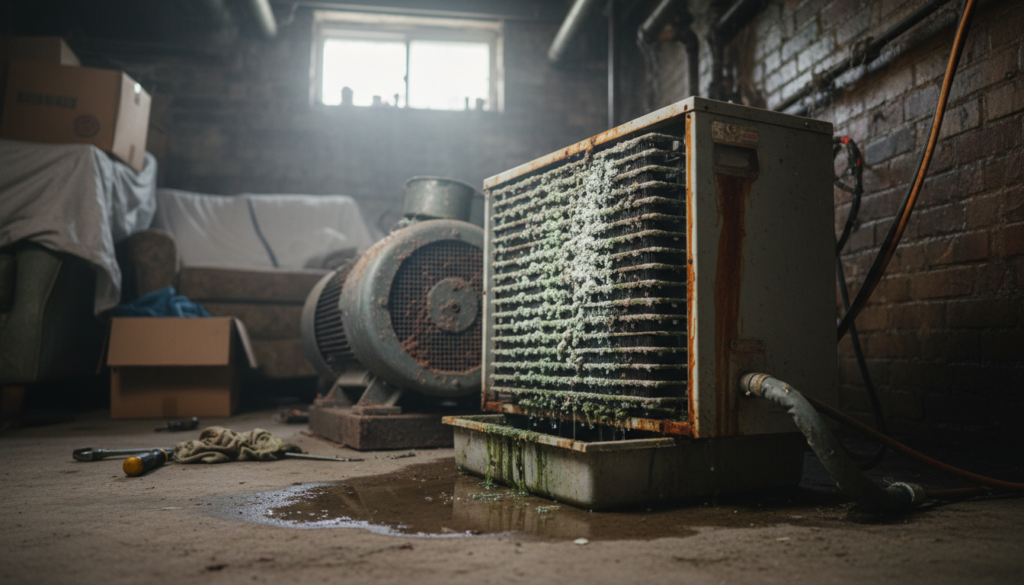
Had a homeowner off Roberson Mill Road call last spring convinced she needed a whole new system. House felt like a swamp, unit running nonstop. We pulled the panel and the drain pan told the whole story: a clogged line and a coil that couldn’t shed condensate. Not a new-system problem. A drain problem.
If your house feels more like a swamp than a living room, don’t just keep cranking the dial down. Give Air Conditioning Specialist Inc. a shout and tell us one thing: is it clicking without starting, or running forever and never dropping the temperature? With locations in Milledgeville and Covington, we’ll run a full airflow and drainage assessment and track down where the real trouble hides. You can also learn more about our duct inspection and cleaning services if airflow is the concern.
By the Air Conditioning Specialist Inc. Team
Frequently Asked Questions
Why does my air conditioner keep freezing up even after I add refrigerant?
A refrigerant top-off does not fix a frozen coil because low refrigerant is rarely the root cause. A sealed HVAC system does not consume refrigerant, so if the charge is low, a leak exists and adding refrigerant without finding and repairing it only delays the next freeze. The more common culprit is restricted airflow from a clogged filter or collapsed return duct, which drops coil temperature below the dew point and turns surface moisture into ice. A proper diagnosis measures both refrigerant charge and static pressure before any refrigerant is added.
How do I know whether my HVAC blower has a motor problem or just debris in the fan?
Debris and balance issues produce sounds that change with fan speed, such as rattling or thumping that shifts in pitch as the blower spins up or down. A failing motor behaves differently: it generates noticeable heat at the housing, hesitates or hums on startup without reaching full speed, or produces a grinding that steadily worsens over several days. A failing blower wheel often sounds like hard objects tumbling inside a dryer. If the noise is constant and mechanical rather than rhythmic with speed changes, the motor or wheel is the likely source.
What is the difference between a 1-inch and a 4-inch media filter, and does it matter which one I use?
The difference is surface area, and it directly affects how hard your blower works. An 1-inch filter slot has far less media area than an 4-inch media cabinet, so a high-MERV filter in an 1-inch slot dramatically increases static pressure, can cause the filter to bow inward, and allows air to bypass around the edges entirely. An 4-inch media cabinet spreads the same filtration across a larger surface, keeping static pressure low enough that older or lower-capacity blowers can maintain proper airflow. Choosing the wrong combination can cause coil icing and premature compressor wear.
What electrical warning signs from an air conditioner mean I should cut power immediately?
A burning smell near the air handler or disconnect, a breaker that trips on startup, or a sharp hot odor at the outdoor unit are all reasons to shut the system off at the breaker and call a technician before resetting anything. Resetting a tripped breaker repeatedly when the compressor is drawing locked rotor amps stresses the motor windings and accelerates failure. Capacitors retain a charge after power is removed, making internal electrical components dangerous to handle without proper equipment. A chattering or buzzing contactor that is not addressed quickly tends to damage the full start kit alongside it.