
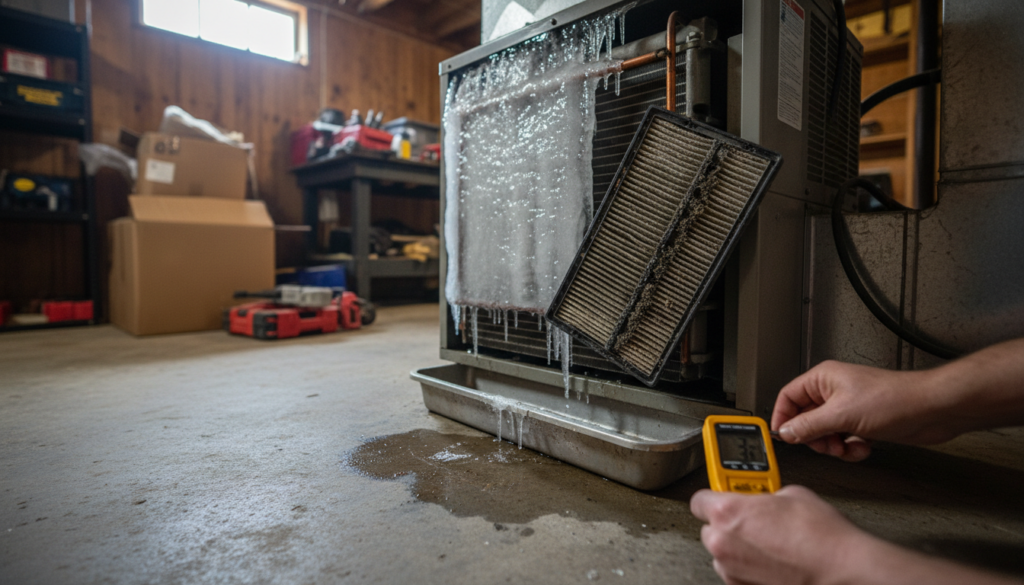
And before you read another word, I want to knock down the biggest lie in this business: cold air at the register doesn’t mean your system is healthy. I hear it every spring. “It’s still cooling fine.” Sure. And a truck with no oil still drives fine, right up until it doesn’t.
The stuff that actually kills systems around here (humidity, pollen, red clay dust, neglected filters) does its damage quietly, months before the house ever feels warm. Our humidity alone can shave 20 to 30 percent off equipment life when a system gets neglected. That isn’t a scare number. That’s just what damp air does to metal and windings over time.
What ACS Covington GA Techs Check First
Airflow. Almost every time, airflow, and the blower motor sitting in the middle of it.
The blower is essentially the heart of the whole system, and it’s also the most ignored part in the industry. Your compressor gets all the attention because it’s the expensive one, but the blower is the one doing the actual work of moving air through your house, and it’s the one your filter habits either protect or slowly strangle.
When you skip filter changes, you are not just breathing dust. You’re forcing that motor to pull against a wall of resistance, and motors that run hot die young. It’s like running with your hand over your mouth. It technically works. Not for long.
I remember a house out near the Covington square where the owner swore the thermostat was bad because cooling was “inconsistent.” Took me about ten minutes to find the real problem: the blower wheel was so caked in gray fuzz it looked like a fossil somebody dug up. That wheel was spinning triple-time to push a whisper of air through the registers. The filter hadn’t been changed in, let’s just say months.
A cleaning at that stage is a modest service ticket. Let it run that way through a Georgia summer and you are into a full motor replacement, and if the control board cooked along with it (which happens more than people think), the invoice gets ugly. Same failure, wildly different bill, and the only difference was a filter, one of the most overlooked benefits of staying current on air filter replacements.
Duct Leaks in Older Covington and Milledgeville Homes
It doesn’t stop at the motor. Middle Georgia hands these systems many weeks of real punishing heat every summer, and a high-efficiency unit typically loses much of its advantage the moment the ductwork leaks or the return is choked. We have spent half my career explaining that a system is only as strong as its weakest duct connection, and in a lot of older Covington and Milledgeville homes those connections are hanging on by tape and prayer.
Actual duct tape, by the way, is about the worst thing you can put on a duct. It dries out and lets go in an attic within a couple of summers. Mastic or foil tape or nothing.
We pulled a return drop apart on Roberson Mill Road last fall where somebody had swapped the panel screws for drywall screws at some point and the whole boot was sucking attic air. The homeowner was paying to cool the attic. Total mess.
The Filter Argument I Keep Having
Now, filters, and I will admit up front this is the part of my own advice I second-guess. I used to tell everyone to buy the highest MERV they could find. I have walked that back. We’ve seen this backfire on 1-inch filter racks where a dense pleated filter bowed inward and let air bypass around the edges, which is an expensive kind of useless. My lead tech disagrees with me here.
He says most modern blowers handle the higher MERV filters fine and I am being old-fashioned about it. He might be right on the newer variable-speed equipment. I still tell people: go higher if your return is sized for it, and confirm the system can handle the static pressure before you do. On a tight 1-inch slot in an older house, a basic pleated filter changed on time beats a premium filter changed never.
Every single time.
Why Systems Fail Here Faster Than Elsewhere
Numbers tell this story better than I can. The humidity penalty I put on neglected equipment in the intro is real, roughly a quarter of a system’s lifespan gone in many cases. The summer load is typically many hard days a year.
And on the other side of the ledger, homes on our maintenance plan see repair needs drop, in many cases significantly. That last number is the one I wish more people sat with, because it’s the only one you control. You can’t vote the humidity down. You can absolutely get the coil cleaned and the drain treated before June.
One more moving target worth knowing about: the industry is transitioning refrigerants, moving from R-410A to R-454B. If your system is older and limping, that transition is part of the repair-or-replace math now, and it’s worth asking about before you sink money into a compressor. We give free quotes on replacement systems, so the asking costs you nothing.
The Capacitor Call We Run All Summer
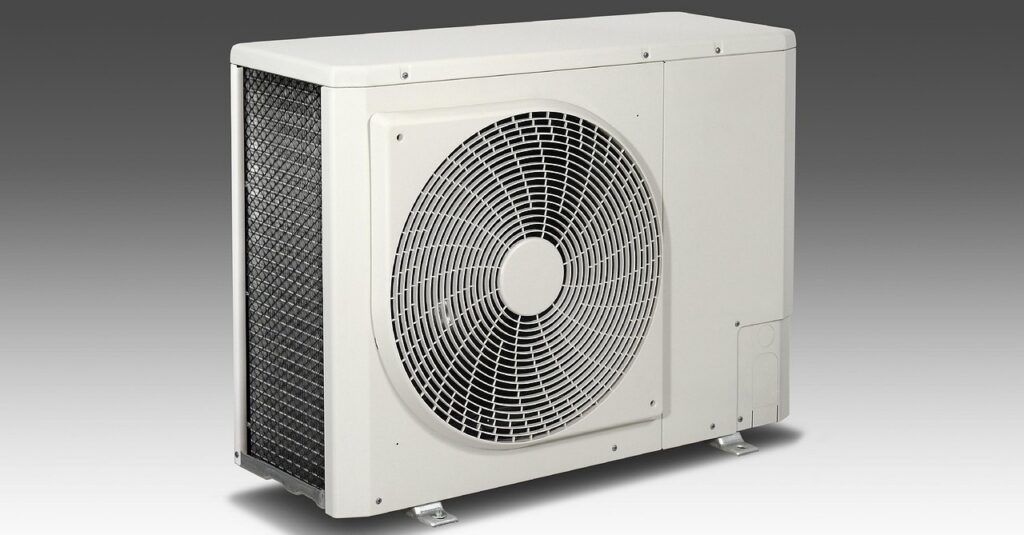
A run capacitor is a part about the size of a soda can, and it’s the single most common reason a Covington homeowner comes home to a dead outdoor unit in July. During one brutal week last summer we swapped out a significant number of them across our service area. Heat kills them, and a unit already running hot from a dirty coil kills them faster.
The symptom is usually an outdoor fan that hums but will not spin, or a unit that clicks and gives up. These rank among the most common HVAC problems we diagnose all season. Don’t stick a stick in the fan to help it start, and don’t go poking at the capacitor yourself, because they hold a charge even with the power off.
Hosing Off the Outdoor Coil, and How People Wreck It
Rinsing your condenser coil with a garden hose is genuinely one of the best free things you can do for your system. Grass clippings, cottonwood fluff, and our red dust build a blanket on those fins, and the unit suffocates behind it. Kill the power at the disconnect first, then rinse gently from the top down.
What people get wrong is the pressure washer. We have seen homeowners fold every fin flat on one whole side of a condenser trying to get it “really clean,” and now the unit breathes worse than it did dirty. Straightening fins is tedious, comb-and-patience work.
The other thing: check where your dryer vent points. If it blows lint at the condenser, that coil will mat up no matter how often you rinse it. Give the unit clearance too, a good two feet on all sides. Shrubs love to hug condensers and condensers hate it back.
Thermostat Placement and Short Cycling
Half the “broken thermostat” calls we run are not broken thermostats. The unit is doing exactly what it’s told, the problem is where it’s being told from.
A thermostat mounted on a wall that catches afternoon sun, or one sitting six feet from a kitchen range, is reading a little bubble of heat and running the whole house off it. The bedrooms freeze, the stat is satisfied, everybody is confused. Relocating one is usually a shorter visit than people expect, unless the wire run fights us.
Short cycling is the other tell. If your system is kicking on and off every five minutes, don’t wait for July to make it worse. Sometimes it’s the thermostat location.
Sometimes it’s a dirty coil, or a float switch doing its job on a backed-up drain. The point is that short cycling is never normal, and every cycle is a hard start on the compressor. Our ac repair techs carry EPA and NATE certifications, and we’re certified Carrier experts, though honestly the diagnostic process is the same no matter whose name is on the cabinet.
You would think after this many years I would stop being surprised by how often it’s the simple stuff. But it’s always the same handful of things. Filter, drain, airflow, placement. The expensive failures are mostly cheap failures that got ignored.
Bigger Is Not Better, and I Will Die on This Hill
The short cycling problem comes back around here, because the other cause I skipped over is an oversized system, and that one is baked in on installation day. Plenty of contractors size up “to be safe,” and plenty of homeowners push for it because bigger sounds like better cooling. It’s the opposite in our climate. An oversized unit blasts the house down to temperature and shuts off before it has run long enough to wring the moisture out of the air.
So you get a cold, clammy house that never feels comfortable at any setting, and a compressor racking up hard starts all day. A properly sized system running long, steady cycles will out-comfort an oversized one every summer of its life, a point backed up by ENERGY STAR’s guidance on correct equipment sizing. If a salesman quotes you tonnage without doing a load calculation on your actual house, get another quote.
Drain Lines, Float Switches, and Water Damage
Water near your indoor unit means you shut the system off. Now. Not after the weekend. Not after you “keep an eye on it.”
Here is why I am sharp about this one. That drain line handles gallons of condensate a day in our humidity, and algae loves a warm, wet PVC pipe. When the primary line slimes shut, the water has to go somewhere, and the secondary pan under an attic unit is the only thing between that water and your ceiling.
Those pans are not decoration. I once pulled a literal slug out of a drain line on a basement unit in Milledgeville that had built a small pond under the return drop. The owner was less than thrilled about the carpet.
If your pan has a float switch, test it. If it doesn’t have one, get one installed, it’s a small job with an oversized payoff. And if your air handler sits over finished living space, drain maintenance isn’t optional spring trivia. Water doesn’t care that you were just testing the AC.
When to Call ACS Covington GA
The week after Memorial Day last year we ran a call off a Milledgeville-area highway, ceiling stain the size of a dinner plate under an attic air handler. The primary drain was slimed shut and somebody, at some point, had bypassed the float switch with a wire nut (that one still bothers me).
The homeowner told me, “We thought the stain was from the roof.” By the time a stain shows, the pan has been losing that fight for a while.
So if you have got water marks, a rattle at startup, or rooms that never even out, tell us what you are seeing. Air Conditioning Specialist Inc. typically runs same-day appointments and responds quickly to true emergencies, with locations serving Covington and Milledgeville. Call (844) 256-6800 and we will put a tech on a full airflow and drainage assessment before the real heat gets here.
By the Air Conditioning Specialist Inc. Team
Frequently Asked Questions
How often should I change my air filter in Covington, GA?
Most Covington homeowners should change standard 1-inch pleated filters every 30 to 60 days, not the 90-day window printed on many filter packaging labels. Central Georgia’s combination of high humidity, heavy pine pollen, and red clay dust loads filters faster than national averages assume. A clogged filter forces the blower motor to pull against restricted airflow, which generates excess heat and accelerates motor wear. A basic pleated filter changed on schedule outperforms a premium high-MERV filter that sits in place for months.
What does a run capacitor do, and why do they fail so often in Georgia summers?
A run capacitor stores and releases the electrical charge that starts and sustains the motors in your outdoor HVAC unit. In Georgia, prolonged heat exposure degrades the internal dielectric fluid inside the capacitor, causing it to lose its ability to hold a charge. Units that already run hot from dirty coils or restricted airflow reach failure thresholds faster. The typical symptom is an outdoor fan that hums but refuses to spin, or a unit that clicks once and shuts down without cooling.
Can high humidity in Middle Georgia actually shorten my AC system’s lifespan?
Yes. Neglected HVAC equipment in high-humidity climates like Central Georgia can lose 20 to 30 percent of its expected service life compared to the same equipment in drier regions. Persistent moisture accelerates oxidation on metal components and degrades motor windings over time. The damage accumulates slowly across cooling seasons, which is why systems often appear to function normally until a major component fails. Keeping coils clean, drain lines clear, and filters current limits the direct exposure of internal components to moisture-laden air.
What is the R-454B refrigerant transition and does it affect older Covington AC systems?
R-454B is the low-global-warming-potential refrigerant replacing R-410A in new residential HVAC equipment following updated federal regulations. Systems manufactured before the transition still use R-410A, but as production of that refrigerant winds down, repair costs involving refrigerant recharge on older equipment are expected to rise. For any Covington homeowner considering a compressor replacement on an aging R-410A system, the refrigerant transition is now a direct factor in whether repair or full replacement makes better financial sense.