
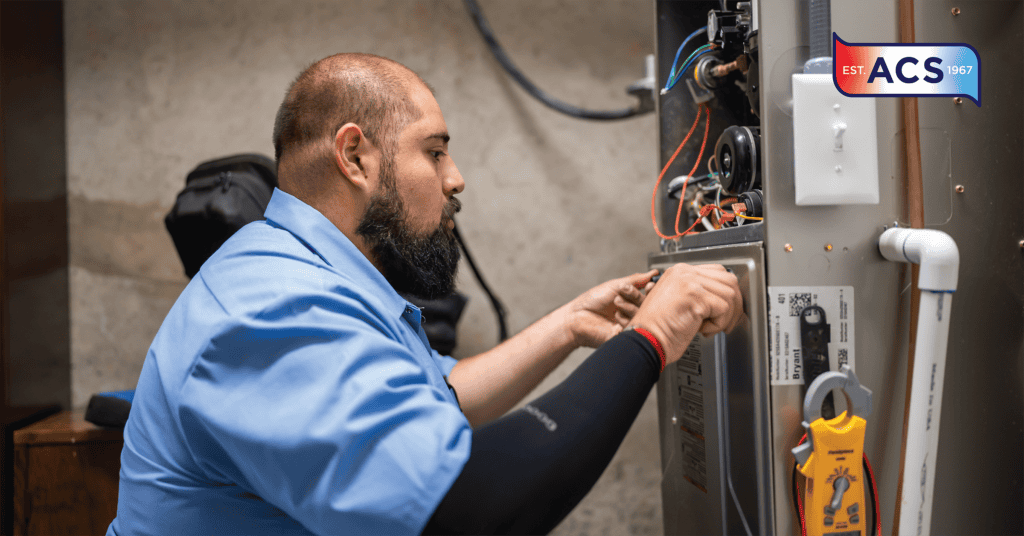
You don’t need to be a technician to do a good chunk of your own furnace maintenance, and if you knock out a few simple habits before the first cold snap, the house stays warmer, the bills come in lower and everybody sleeps a little safer all winter. None of the nine furnace maintenance tips we’re going to walk through need any special training, and most of them take you less than fifteen minutes. Put together, they get your furnace into the season clean, breathing easy and ready to work hard.
This year we think that matters more than usual for folks in central and north Georgia. The forecasters are expecting a Super El Niño winter, which means sharp swings between mild days and Arctic cold plus a higher chance of ice storms, and a furnace that’s starting and stopping all season long can use every bit of help you’re able to give it.
Before we get into the furnace maintenance tips themselves, here are a few numbers that explain why a little furnace maintenance now pays you back later:
- Nothing in your house uses more energy than heating and cooling. When the U.S. Energy Information Administration broke it down, space heating and air conditioning came to 52% of a typical household’s annual energy use, so a furnace that’s starved for air or running on bad settings is throwing money away every day it’s on.
- Winter is when heating fires happen, by a wide margin. The National Fire Protection Association says there were 37,365 home heating equipment fires a year on average from 2020 to 2024, and nearly half of those happened between December and February.
- Just setting your thermostat smarter can take a bite out of heating costs. By the U.S. Department of Energy’s estimate, you could save roughly 10% a year on heating and cooling by actually using a programmable thermostat the way it was meant to be used.
We’ll be upfront that homeowner furnace maintenance doesn’t replace the yearly professional tune up. What it does is make that visit go further, and it helps you catch trouble early, so let’s cover a few basics first and then go through all nine one at a time.
Before you start: furnace maintenance basics
Most people we talk to jump straight to the filter and skip this part of furnace maintenance completely, which we understand, but it only takes about five minutes and it makes everything after it safer. Mainly you want to know what you’re working on and how to turn it off, and after that it’s just a few cheap tools.
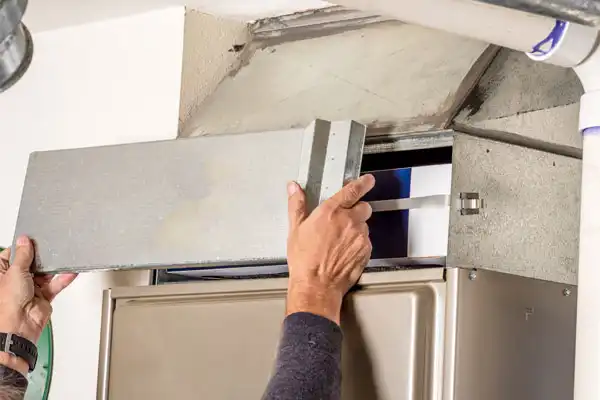
Know what kind of system you have
In most Georgia homes we walk into, the heat comes from a gas furnace, an electric heat pump or a dual fuel system that uses both. The gas furnace lives indoors, usually in a closet, basement, attic or crawl space, and it’s hooked to a metal vent pipe that carries the exhaust outside. A heat pump has an outdoor unit that looks just like an air conditioner, with an indoor air handler that goes with it.
Somewhere on your indoor unit there’s a label with the brand, the model number and a lot of times the year it was built, and we’d really recommend snapping a photo of it with your phone. You’d be amazed how often that one picture saves a trip to the hardware store, since it’s how you buy the right filter, how you look up the warranty, and what we’ll ask you for first if you ever call us about service.
Shut off power the safe way before any furnace maintenance
Nobody should be opening a panel or reaching inside the cabinet while the system can still turn on. So start at the thermostat and set it to off, and then go hunt down the service switch near the furnace, which on most of the houses we see looks like a plain old light switch screwed onto the unit or the wall right next to it. If you want to be extra careful (we always are), flip off the furnace breaker in your electrical panel too.
None of the furnace maintenance tips in this article need the gas turned off, and you should never try to adjust gas valves, burners or gas lines yourself. If you ever smell gas, which a lot of people describe as rotten eggs, get out of the house right away and call your gas utility once you’re outside.
Simple tools to keep on hand
You really don’t need a full toolbox for any of this. A flashlight is handy for dark closets and attics, a soft brush and a shop vacuum take care of the dust around the unit and the vents, and on some models you’ll want a screwdriver for the filter door and access panels.
Beyond that, it’s nice to have a couple of spare filters in the right size, fresh batteries for the thermostat and the detectors, and some kind of log, even just a note on your phone, where you write down what you did and what day you did it. Our techs love walking into a house where somebody kept that log, because it tells us a lot before we’ve even opened the furnace, and it can settle a warranty question later on too.
Airflow furnace maintenance tips that help it breathe
We like to tell people a furnace is basically a big fan sitting in front of a fire. If the air can’t get through, the heat can’t either, so these first three furnace maintenance tips are all about getting stuff out of the way of that air before the blower burns itself out trying.
Tip 1: Change your air filter
If you only do one thing on this whole furnace maintenance list, change the filter. A clogged one chokes off airflow, the blower has to work harder to compensate, and the furnace can actually overheat. Many furnaces have a safety switch that shuts them down once they get too hot, so believe it or not, a dirty filter by itself can be the reason for a no-heat call.
For most standard 1 inch filters, we’d check them monthly when the heat’s running a lot and replace them every one to three months. If you’ve got pets, allergies or a recent remodel in the house, you might need to change them more often, while the thicker 4 or 5 inch media filters usually last longer. There’s an arrow on the frame, and it should point toward the furnace, the way the air flows (if you’re not sure which filter you need, we put together a guide on which air filter to buy).
Tip 2: Open and clear every vent and return
Take a walk around the house and look at every supply vent, the ones blowing warm air out, and every return grille, which are the bigger ones pulling air back to the furnace. What you’re checking for is furniture, rugs, curtains or boxes sitting in front of them.
Now, we get why people close the vents in the guest room, since it seems like it should push more heat to the rooms you actually use. In most homes it does the opposite, because shutting vents raises the pressure inside the ductwork, and that pressure is what cuts your airflow, strains the blower and gives you one room that’s toasty and another that never warms up (here’s why keeping your vents open matters). Our advice is to leave them all open, and since you’re already down there looking, run a damp cloth or the vacuum brush over the grilles to get the dust off.
Tip 3: Clear the space around your furnace
Furnace closets and utility rooms have a way of turning into storage over the years. Paint cans, cleaning supplies, laundry and cardboard boxes have no business sitting next to a gas furnace, because they can block the air it needs to burn safely, and some of that stuff is a fire hazard on its own.
The rule of thumb we give everybody is at least three feet of open space around the furnace and the water heater, and if that sounds like a lot, it’s because it’s supposed to be. Getting the dust and lint up from around the base of the unit is part of good furnace maintenance too. For furnaces up in an attic or down in a crawl space, this part of your furnace maintenance also means checking for debris, for some critter that decided to move in, or for insulation that’s been torn up around the unit and the ductwork.
Furnace maintenance safety tips every homeowner should follow
Keep in mind that a gas furnace is literally burning fuel inside your house, which is why we think a few quick safety checks belong on everybody’s fall list. These take a few minutes, and they’re the part of home furnace maintenance that can really make a difference for your family.
Tip 4: Test your carbon monoxide and smoke detectors first
The scary thing about carbon monoxide, the gas that comes off anything burning fuel, is that you can’t see it and you can’t smell it. So when a furnace has a cracked heat exchanger or a vent that’s blocked up, it can leak into the house without giving you any sign at all, and the only thing standing between your family and that gas is a detector with good batteries in it.
Go push the test button on every carbon monoxide and smoke detector in the house, swap the batteries if they’re weak, and look at the date printed on the back. Most carbon monoxide alarms need replacing every five to seven years, and you want one on every level of your home and near the bedrooms (we go deeper on this in why you should check your carbon monoxide detectors before winter).
Tip 5: Check the outdoor vent and flue
Your furnace gets rid of its exhaust one of two ways, either up a metal flue or, if it’s a high-efficiency model, out through a pair of white plastic pipes poking out of a wall or the roof. Either way, if those openings get blocked, that exhaust has nowhere to go but back into the house, and that’s the whole reason this tip is on the list.
Take a lap around the outside of the house as part of your furnace maintenance and find those vent openings, and pull off whatever’s collected on them, whether it’s leaves, a bird’s nest, a shrub that got out of hand or just general junk. On high-efficiency furnaces we always check that both pipes are open, the intake and the exhaust, and it’s smart to look again after any heavy wind, ice or snow this winter. Then come back inside and give the metal flue pipe a once-over for rust, gaps or a section that’s come loose, and if something doesn’t look right to you, that’s when you call a professional.
Tip 6: Look at the burner flame
This one sounds technical, but it really isn’t, because a lot of gas furnaces come with a little viewing window that lets you watch the burners while the thing is running. You don’t open anything at all, you just turn the heat up, wait for the burners to catch, and peek in.
A good flame is steady and mostly blue, pretty much like the burner on a gas stove that’s working right. Yellow or orange is a different story, and so is a flame that flickers or lifts up off the burner, because we usually trace those back to dirty burners, poor air supply or a combustion problem, and if there’s soot around the furnace we take that seriously too. If you see any of that, turn the system off and get a professional inspection on the calendar instead of trying to adjust it yourself.
Efficiency furnace maintenance tips that lower your winter bills
The last three furnace maintenance tips are all about getting more heat out of every dollar you spend. They come in especially handy in a winter full of temperature swings, since your system is going to be starting and stopping more often than usual.
Tip 7: Test and program your thermostat
More than once we’ve shown up for a “dead” furnace and found the thermostat still set to cool from back in September. Flip yours over to heat, push the setting a few degrees above whatever the room is sitting at, and then wait a minute or two for the furnace to come on with warm air close behind. If it stays quiet on you, we’d bet on dead batteries or a tripped breaker before anything else, and those are both things you can check yourself before you ever pick up the phone.
The savings come from the schedule, and it should match how your family actually lives. If the house is cooler while everybody’s asleep or at work and warms back up before you walk in the door, you’re getting about the easiest money back that furnace maintenance has to offer. If you’d rather not think about it at all, a smart thermostat learns your habits and makes the adjustments on its own, and that’s a real help on those mild afternoons that turn into freezing nights (our smart thermostat installation folks can set one up for you).
Tip 8: Check the condensate line
Here’s one that surprises people. A high-efficiency gas furnace or a heat pump actually makes water while it runs, and it gets rid of it through a skinny plastic tube that heads off to a floor drain, a little pump or straight out through the wall. We’ve seen what happens when that tube clogs. Either a safety switch trips and the heat cuts out on you, or somebody walks into the utility room in their socks and finds the puddle the hard way.
For this bit of furnace maintenance you just follow that tube away from the furnace and look for anywhere it’s kinked, cracked or dripping. If there’s a condensate pump on yours, pour a little water into its reservoir, and if the pump is healthy it’ll click on all by itself a second later. This winter is supposed to run wetter and more humid than usual, and a drain line that works keeps that moisture and the mold that follows it out of your utility area, so it’s a furnace maintenance step we wouldn’t skip.
Tip 9: Clear the outdoor unit and air intakes
With a heat pump or a dual fuel system, that box out in the yard is doing most of the work all winter, and it can’t do it buried in azaleas. We’d trim things back until it has about two feet of room on every side and then pull the leaves and pine straw off the top and out of the coil fins. Some folks want to throw a tarp over it for the winter, and please don’t, because a heat pump needs open air around it to heat your home at all.
On a cold morning you might see it go into a defrost cycle and send up a cloud of steam, which looks alarming but is completely normal. What isn’t normal is a unit that stays covered in thick ice for hours on end, and that’s one we’d want to come look at. After an ice storm it’s fine to gently clear the ice and snow away from around the base, but whatever you do, don’t go chipping ice off the coils, because those fins bend if you look at them wrong.
What to leave to a professional
Homeowner furnace maintenance covers the outside of your heating system, and that’s where we’d like it to stay. The inside, where gas, fire, electricity and refrigerant all come together, is for a trained technician with the right tools and the safety training to go with them.
Furnace parts that need expert hands
Some of the most important furnace checks happen behind sealed panels. Once those panels come off, the first thing our guys look at is the heat exchanger, since a crack there is how carbon monoxide gets out. From there it’s gas pressure, the igniter, the safety switches, and a cleaning for the burners and the flame sensor. On a heat pump the tech will also want to see where the refrigerant is sitting and whether the defrost controls kick in when they’re supposed to.
That work means live gas lines, high voltage and sensitive electronics. Get it wrong and you can create a safety hazard, damage expensive parts or void your manufacturer warranty, which is why the nine furnace maintenance tips above were picked to be safe for homeowners, and anything beyond them we’d honestly rather you leave to a pro.
Signs your furnace needs more than DIY furnace maintenance
You can do every one of these tips perfectly and still have a furnace with a real problem, because basic furnace maintenance only reaches so far. We’d want a call if yours clicks on and off every few minutes, if it’s started banging or squealing, or if the air coming out feels cool when the heat is supposedly on. We’d also want to hear about the bedroom at the end of the hall that never warms up, a bill that jumped when nothing else changed, and any burning smell that’s still around after day one, since in our experience those point to something deeper inside.
Then there are the ones that can’t wait until tomorrow, like a yellow or flickering flame, soot showing up near the furnace, or your carbon monoxide detector going off. When that alarm sounds, get everybody out of the house first and then call 911 or your gas utility, and the same goes if you ever smell gas, where you leave first and only make the call once you’re outside.
Why DIY plus a yearly tune up works best
What works best, from what we’ve seen, is doing both kinds of furnace maintenance. Your part is the monthly stuff, like the filter and the vents and a quick look at the detectors, and that keeps things running smoothly between visits. Our part is the yearly professional tune up, where we get into the deep cleaning and testing and the adjustments nobody should be doing without the training.
So we really do see furnace maintenance as something we do together with you. When our tech shows up to a clean filter, a clear closet and a log of what you’ve noticed, they can spend the visit finding real problems instead of doing basic cleanup. A lot of homeowners also go with a maintenance plan, like our Comfort Club, which books the visit automatically and usually gets you priority service when the cold weather brings a rush of calls.
Your home furnace maintenance questions, answered
How often should I change my furnace filter?
With the standard 1 inch filters, we’d look at them once a month while the heat is running and plan on swapping them every one to three months. If you’ve got pets or somebody with allergies, you’ll probably be changing them more often than that, though the thicker 4 or 5 inch filters tend to go a good while longer.
Is it safe to do my own furnace maintenance?
Most of it is, as long as your furnace maintenance stays on the outside of the cabinet, so think filters, vents, detectors and thermostat programming. Once you’re talking about gas lines, burners, the electrical side or refrigerant, that’s where we’d ask you to hand it off to a trained technician.
Should I close vents in rooms I do not use?
It feels like it should help, we know, but in almost every house we’ve been in the answer is no. Somebody sized your ductwork assuming every vent would be open, and shutting a few makes the pressure climb, which is hard on the blower and tends to leave you with a couple of rooms that never feel like the rest of the house.
What color should my furnace flame be?
Steady and mostly blue is what a healthy one looks like. A yellow, orange or flickering flame, or any soot around the furnace, can be a sign of a combustion problem, and that’s something we’d want a professional to come inspect.
How much space should I leave around my furnace?
About three feet of clear space all the way around is what we recommend, and you’ll want the same around the water heater. And please don’t keep paint, cleaning chemicals, laundry or boxes right up against gas heating equipment, even if that closet is the only storage you’ve got.
Do I still need a professional tune up if I do my own furnace maintenance?
You still do, and we’d tell you that even if you’re the most careful person on your street about your own furnace maintenance. You keep the system clean and breathing, but only a technician can inspect the heat exchanger, test gas pressure, clean the burners and confirm the safety controls work, and doing both is what gives you the best protection.
Why is furnace maintenance more important this winter?
The forecast calls for a strong El Niño, and for Georgia that usually means a wetter winter with sharp temperature swings and a higher risk of ice storms. That adds up to more furnace starts and more stress on the parts, so a system that goes into the season clean and checked is a lot less likely to fail on you.
Need help getting your furnace winter ready?
These nine furnace maintenance tips give your furnace a good start, but some jobs really do need a trained eye. If you spot a warning sign, or you’d just like some peace of mind before the first cold snap, The Air Conditioning Specialist is here to help.
Our technicians take care of homeowners in Covington, Milledgeville, Augusta, Athens and the surrounding Georgia communities, and our furnace maintenance visits cover the deep cleaning, safety testing and adjustments that keep a furnace running safely and efficiently all winter. Give us a call to book your furnace maintenance visit, and we’ll get you on the schedule so you stay warm no matter what this winter throws at us.