
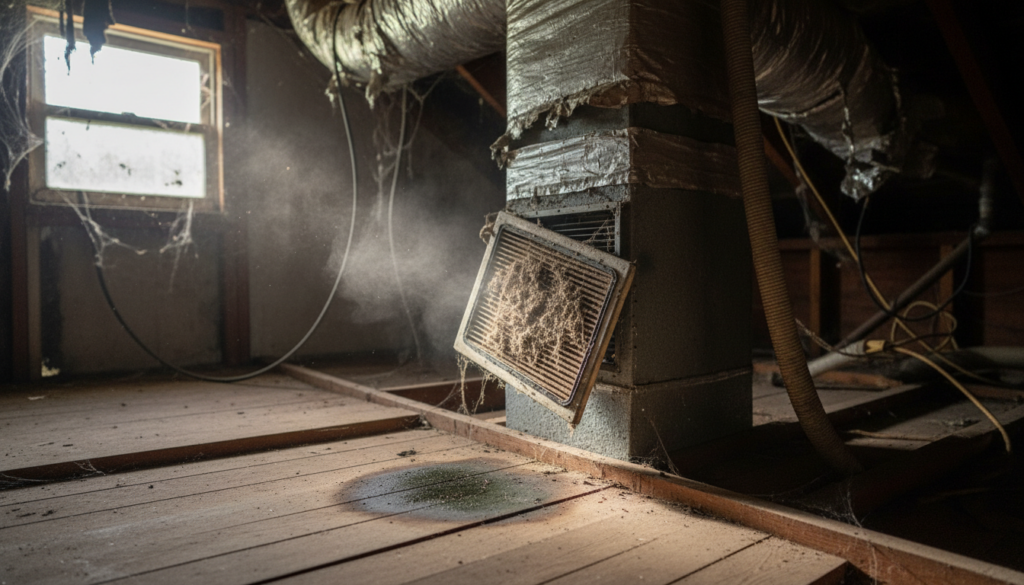
The most effective indoor air quality solutions for Milledgeville, Georgia homes are whole-home dehumidification, properly sized filtration, and sealed ductwork, in that order. Most houses around Milledgeville have worse air inside than outside, and the AC running all day doesn’t fix that by itself. Air Conditioning Specialist Inc. has been working on Middle Georgia systems since 1967, and after that long the pattern is boring in its consistency: moisture nobody manages, filters nobody sizes correctly, and ductwork in older Baldwin County homes that leaks conditioned air into places you will never see. The thermostat can read a comfortable setpoint all day and the house still feels heavy. That feeling is your air quality talking, and it usually has nothing to do with the setpoint.
So this guide covers the stuff that actually moves the needle around here: humidity first, filtration second, and how to know when you’re past the do-it-yourself stage.
Humidity Control: The Foundation of Indoor Air Quality Solutions in Baldwin County
Whole-home dehumidifiers are the single most impactful Indoor Air Quality Solutions upgrade for Milledgeville homes, because humidity is the dominant air quality problem in this part of Georgia and everything else sits downstream of it. Georgia humidity doesn’t just make the house feel sticky. It feeds mold in the ductwork, it makes dust cling to registers, it lets dust mites thrive, and it quietly shortens the life of your equipment. High-humidity operation can shave 20 to 30 percent off a system’s expected lifespan, and we run our systems hard here. Milledgeville sees many days of real summer heat a year, and every one of those days your evaporator coil is pulling gallons of water out of the air. Where that water goes, and whether the system removes enough of it, decides whether your house smells like a house or smells like a basement.
The EPA estimates that indoor air pollutant levels are often 2 to 5 times higher than outdoor levels, and in humid climates like Baldwin County’s, moisture is the primary driver of that gap, because it accelerates mold growth, dust mite populations, and VOC off-gassing simultaneously.
Here’s a call that stuck with me. A homeowner over in Covington had spring allergies bad, so he bought the tightest filter the hardware store sold and jammed it in an 1-inch slot. Systems like his typically aren’t rated for that kind of static pressure increase. The blower strained, airflow dropped, the coil ran colder and wetter than it should, and the house got muggier while he congratulated himself on the clean air. We’ve seen this backfire enough times that I now check the filter before I check anything else. He wanted cleaner air and accidentally built a swamp in his ductwork.
Now, on the question of exactly how high you can push filtration, I will be honest that I have changed my answer more than once over the years. I used to tell people MERV 13 was fine on almost anything modern. I have walked that back. Then I walked the walk-back partway back, because the newer variable-speed equipment (Carrier’s included, and we’re certified Carrier people) handles tighter media better than I gave it credit for.
Where I have landed, for now, is this: the MERV rating matters less than whether your return ductwork was sized for it, and in older Milledgeville homes that’s honestly a coin flip. ASHRAE Standard 62.2 sets minimum ventilation rates for residential buildings, and a system already undersized on return area has no margin left when you step up to MERV 11 or 13 media, the added static pressure drop tips it into the same airflow problem that Covington homeowner created. Confirm your system can handle the static pressure before you go up a grade. If your tech can’t tell you what your static pressure is, find a different tech.
Whole-home dehumidifiers earn their keep here in a way they would not in Arizona. So do properly sized media cabinets. But the equipment is the second step, not the first.
If the air can’t move through the house, the hardware is decoration. We manage humidity levels before we recommend anything with a price tag, because bolting a dehumidifier onto a system that can’t circulate is treating the symptom while the disease keeps eating.
And check the simple stuff. Fan switched to On instead of Auto is the muggy-house setting. We hear “we turned the fan on to help circulate” constantly, and the house immediately feels wetter, because the fan re-evaporates the water sitting on the coil and blows it right back into the rooms.
I will interrupt myself here, because this is the part that genuinely bothers me about this work. People treat indoor air as an afterthought until the smell or the dust becomes impossible to ignore, and by then the fix costs real money. The early signs were sitting right there in the mechanical closet the whole time. Nobody looked. You would think after this many years I would stop being surprised by it. I have not.
Whole-Home Filtration, UV Lights, and Air Purifiers for Milledgeville Homes
A whole-house air filtration setup is the most effective filter solution for most Milledgeville homes, it cleans every cubic foot of air the system moves, which is what separates it from the plug-in room units people buy three of and give up on. For most homes around Milledgeville, an 4-inch media cabinet is the workhorse. More surface area means you can filter tighter without choking the blower.
The table below compares the four most common IAQ equipment options across the dimensions that matter for Baldwin County conditions:
| Solution | Primary Problem Addressed | Maintenance Interval | Best Use Case |
|---|---|---|---|
| Whole-home dehumidifier | Excess humidity, mold risk, dust mites | Annual service, check drain monthly | Any Baldwin County home with persistent stuffiness or musty odor |
| 4-inch media cabinet (MERV 11 to 13) | Airborne particulates, pollen, dust | Filter replacement every 6 to 12 months | Homes with allergy sufferers; older homes with leaky returns |
| UV coil/drain pan light | Biological growth on coil and drain pan surfaces | Bulb replacement every 1 to 2 years | Homes with recurring musty startup odor; coils prone to slime buildup |
| Whole-home electronic air purifier | Fine particulates, some VOCs | Cell cleaning every 1 to 3 months | New tighter construction where ventilation is limited |
UV lights have a real job, but it’s narrower than the marketing suggests: they keep the coil and drain pan surfaces from growing the biological slime that causes that musty smell, and that’s roughly it. They aren’t a substitute for filtration and they do not remove dust. We install plenty of UV lights and purification equipment and I will still tell you a clean coil and a managed drain matter more.
Every March the pollen coats everything here. Your truck is yellow, your dog is yellow, the porch furniture is yellow, and your system is trying to breathe through all of it. That’s the season people panic-buy filtration.
Fine. But before you spend money on hardware, the EPA’s indoor air quality guidance recommends starting with source control and ventilation before layering on equipment, and that tracks with what we see in the field.
Pull the filter and hold it to the light. If you can’t see through most of the pleats, that’s your problem, and it costs almost nothing to fix. Walk every return grille. We have pulled baby gates, shoe racks, and once a full laundry hamper off return grilles. People use them as furniture. The grille can’t breathe through your linen collection. Smell the first thirty seconds of a cooling cycle. Musty at startup usually means coil or drain pan growth, and no filter upgrade fixes that. Look at the flex duct in the attic if you can get to it safely. Crushed or kinked runs are shockingly common in the older neighborhoods off the main roads through Baldwin County, and a crushed duct starves a room no matter what equipment you buy.
Duct cleaning, including knowing the signs you need ductwork cleaning before the problem compounds, deserves an honest word, because people ask about it as if it were a cure-all. It has its place. Ducts full of construction debris or rodent evidence, absolutely. But duct cleaning doesn’t fix leaky duct design, and it never ceases to amaze me how many folks expect it to. Clean a duct that leaks at every joint and you now have a very clean duct pulling attic air into your supply stream.
When Indoor Air Quality Problems Require a Professional
You’re past the DIY stage the moment you see ice on the refrigerant lines or an electric bill spike you can’t explain, stop there and call a professional rather than keep running the system to see if it clears up.
And if a breaker trips on startup, do not stand there resetting it to watch what happens. You’re stressing components that do not forgive repetition, and capacitors hold a charge even after the power is cut. This is not a YouTube afternoon.
The thing we find most often on air quality and repair calls is almost funny. A spotless, expensive filter installed six inches away from an evaporator coil so coated in growth it looks like wet felt. The filter was protecting a coil that was already lost. The coil, not the filter, was the real source of the smell and the humidity, and no amount of filter swapping was ever going to touch it.
Marcus Webb, Lead HVAC Technician at Air Conditioning Specialist Inc., puts it this way: “the filter tells you what the homeowner did, the coil tells you what actually happened.” He is right, and I have stopped arguing about it.
Professional testing matters too. The Georgia Department of Public Health’s indoor air quality resources outline why actual measurements, static pressure readings, humidity levels room by room, beat guessing every single time. It tells you whether you have a circulation problem, a moisture problem, or a filtration problem, and those three have completely different fixes.
Regular maintenance is the cheapest insurance in this whole conversation. Systems on a consistent maintenance schedule typically see a meaningful reduction in breakdowns compared to systems that only get attention when they fail, which is why our maintenance plan exists in the first place. And when something does let go in July, we target a rapid response on emergencies, because a dead system in a Georgia August is not a wait-until-Thursday situation.
One more field note. We replace more rusted-out secondary drain pans in a warm April than in the peak of July. That’s not a coincidence. That’s a winter’s worth of neglect showing up on the first humid stretch.
IAQ Solutions for Older Baldwin County Homes: Ductwork and Airflow First
Older homes in Baldwin County need a different playbook than new construction, and the ductwork is the reason, sealing and balancing leaky duct systems is the highest-impact first step before any equipment upgrade. A lot of homes around North Wayne and out toward Lake Sinclair are running duct systems that predate any thought of sealing, and leaky returns pull crawlspace and attic air straight into the living space. The EPA notes that source control, eliminating the pathway for pollutants to enter, is more effective than air cleaning alone, and a leaky return duct is about as direct a pollution pathway as you can have. You can install the finest purifier made and it will spend its whole life cleaning air you never should have been breathing. Sealing and balancing come first in these homes.
Sometimes that’s the entire fix. The homeowner braced for a big equipment purchase and instead needed duct sealing and a properly sized return, and the stuffiness they had lived with for a decade was gone in an afternoon. But sometimes the ducts are past saving, and then you’re into a bigger conversation about redesign. There’s no way to know which situation you’re in without someone actually crawling up there and looking, which is less fun than it sounds in a Georgia attic.
In many cases, a guest bedroom that never feels dry no matter what the thermostat says turns out to have nothing to do with the equipment in the mechanical room. She had already bought two portable dehumidifiers and a room purifier. The actual problem was a return duct that had pulled loose in the attic, sucking humid attic air into the system every minute it ran. One repair, problem gone, three appliances back in their boxes.
If some room in your house never feels right, describe the symptom to us before you buy anything else. Air Conditioning Specialist Inc. serves Milledgeville and Covington from multiple Georgia locations, and we will start with an indoor air quality assessment, not a sales pitch.
By the Air Conditioning Specialist Inc. Team
Frequently Asked Questions Indoor Air Quality Solutions
What is the biggest indoor air quality problem for homes in Milledgeville, Georgia?
Humidity is the dominant indoor air quality problem in Milledgeville and throughout Middle Georgia. High indoor humidity feeds mold growth in ductwork, allows dust mites to thrive, causes musty odors, and can reduce HVAC equipment lifespan by 20 to 30 percent because systems in this climate run hard for extended periods. Filtration and purification upgrades will underperform until humidity is brought under control first, typically through proper system operation and, in many homes, a whole-home dehumidifier.
Does a higher MERV filter actually improve indoor air quality in older Baldwin County homes?
A higher MERV filter improves particle capture only when the return ductwork is sized to handle the added static pressure. In older Baldwin County homes, that sizing is frequently inadequate, and forcing a tight filter into an undersized system reduces airflow, causes the evaporator coil to run colder and wetter, and can make indoor humidity worse rather than better. Before upgrading filter grade, confirm your system’s static pressure rating with a technician who can measure it directly.
What do whole-home UV lights actually do for Indoor Air Quality Solutions, and what can they not do?
Whole-home UV lights are designed to prevent biological growth, primarily mold and microbial slime, on the evaporator coil and drain pan surfaces, which is the source of the musty odor common in humid climates. They do not remove dust, pollen, or airborne particles, and they are not a substitute for mechanical filtration. A UV light installed alongside a properly sized media cabinet addresses both biological and particulate concerns, but neither replaces humidity management as the foundational step.
Why does switching the HVAC fan to “On” instead of “Auto” make a Milledgeville home feel more humid?
Running the fan continuously on the “On” setting re-evaporates moisture that has already condensed and collected on the evaporator coil, then pushes that moisture back into the living space. In “Auto” mode, the fan stops between cooling cycles and allows the coil to drain properly. In a humid Georgia climate, continuous fan operation is one of the most common causes of unexplained indoor humidity complaints and is frequently the first thing to check before pursuing equipment upgrades.