
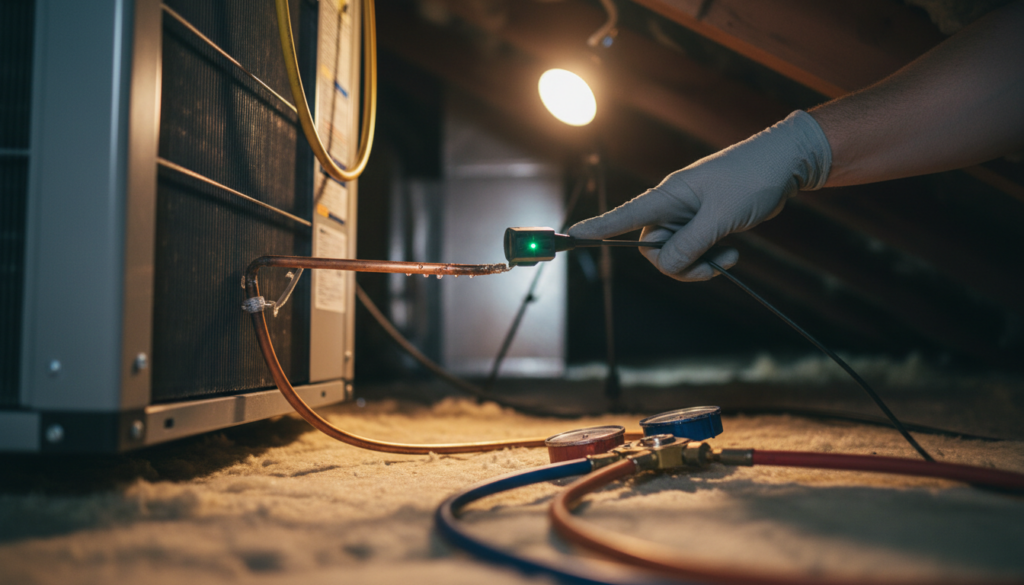
We get asked this every single fall, usually by someone standing in their hallway looking at a furnace that “seems fine,” and our honest answer is yes, a furnace tune up is worth it, and this winter it’s probably worth a little more than it normally would be. One visit a year is how we find the tired part before it turns into a no-heat call on the coldest night in January. It’s also how you keep the burners firing safely, keep the warranty people happy, and keep the furnace from burning extra energy just to keep the house where you like it.
Now, nobody is going to confuse a Georgia winter with a Minnesota one, but anybody who has lived here a while knows they can get weird. You’ll have a mild afternoon with the kids out in shorts and then a hard freeze that same night, and your furnace ends up kicking on and shutting off over and over just to keep up with it. That stop-and-go is honestly harder on the parts than steady cold would be. Forecasters are already saying the 2026 to 2027 winter could be even less predictable than normal, which is why fall is when we’d want to be looking at your heating system.
We like showing people a few numbers here, because they make the case better than we can:
- Heating and cooling are the biggest energy users in your house, and it isn’t close. When the U.S. Energy Information Administration looked at it, space heating and air conditioning came out to 52% of what a typical household uses in a year, which is why we keep telling people an inefficient furnace is not a small problem.
- Heating equipment starts tens of thousands of house fires a year, believe it or not. Most folks we mention this to don’t believe it at first. From 2020 to 2024 the National Fire Protection Association says there were 37,365 home heating equipment fires a year on average, they did $1.2 billion in property damage, and close to half of them happened between December and February.
- Carbon monoxide puts more than 20,000 Americans in the emergency room every year. On top of that, the CDC counts more than 400 deaths a year from unintentional carbon monoxide poisoning, and the exposures climb in the winter months, which is exactly when gas furnaces and heaters work the hardest.
Most of that can be prevented, and that’s really the point of this whole article. We’ll go through what a furnace tune up actually involves, what our guys are looking for once the cabinet panel comes off, and how to figure out if it’s worth the money for your house in particular.

What a furnace tune up really is
Think of a furnace tune up as a planned, hands-on visit where somebody who knows the equipment inspects and cleans your heating system before you need it. We compare it to the oil change and once-over you’d get on the car before a long drive, because nothing is broken yet (and if we’re doing our job right, nothing will be).
A furnace tune up is prevention, not repair
People call us for a repair once something has already gone sideways, like a cold house, a noise nobody can identify, or a furnace that just won’t start. The furnace tune up happens long before any of that, on some mild October morning when nobody at home is uncomfortable yet.
What we do during a furnace tune up is pretty simple to describe. Anything that collects dust and soot gets cleaned, anything that wears out gets tested, and then we adjust the system until it’s running the way the manufacturer meant it to run when it left the factory. Say we find a weak part during your furnace tune up, because you’d much rather hear about it from us in October than find out at midnight in January, and that way you get to pick when and how it gets fixed instead of the furnace picking for you.
How a furnace tune up differs from a quick filter change
Plenty of homeowners change their own air filter and assume that’s the maintenance handled, and we’d never talk anybody out of changing their filter, because it’s one of the best habits you can have. The catch is that a filter only touches one piece of a machine that has dozens of moving parts in it.
Your filter has no way of telling you the flame sensor is coated in gunk, or that the blower motor is pulling more power than it should, or that a crack is starting in the heat exchanger. You only find those things with training, the right test meters, and the panel off where the gas lines and wiring are, and that’s the part of the job a professional furnace tune up exists for.
Gas furnaces, heat pumps and dual fuel systems
In central and north Georgia, almost every house we walk into heats with one of three setups. A gas furnace burns natural gas or propane to make heat, while a heat pump runs on electricity and pulls heat out of the outdoor air to move it inside. Dual fuel is the combination of the two, with the system flipping from the heat pump to the gas side once it gets cold enough outside.
The checklist changes a little with each one. With gas, most of our attention goes to the burners, the venting and combustion safety, and with a heat pump we care more about refrigerant, the outdoor coil and the defrost cycle. Dual fuel gets all of it, plus a look at whether the switchover is happening at the right outdoor temperature, so the visit really should be built around whatever equipment you’ve got.
What pros check during a furnace tune up
Our furnace tune up runs off a checklist, and the order on it never changes: safety first, then performance, then airflow. Here’s what we look at, step by step, and why you should care about each piece.
Safety checks that protect your family
On any gas furnace tune up, safety is where we start. The first thing the tech looks at is the heat exchanger, the metal chamber whose whole job is keeping the fire inside the furnace away from the air your family breathes. That metal heats up and cools down thousands of times over the years, and all that expanding and contracting is how cracks form, and a cracked heat exchanger can let carbon monoxide into the house.
After that we look at the flue and the venting, because exhaust needs a clean path out of the house. We’ll test the gas pressure, check the fittings for leaks, and make sure the safety switches actually shut the furnace down when they’re supposed to. Most of our techs also sniff the air around the furnace with a carbon monoxide meter, and they’ll nag you (nicely) to check your carbon monoxide detectors before winter.
Performance checks that keep heat steady
Then we get into the parts that make the heat. The burners get cleaned so they light evenly and burn that clean blue flame you want to see, and so does the flame sensor, which is a skinny little rod that tells the furnace the burners actually lit. When we hear “it starts, runs a few seconds, then quits,” a dirty flame sensor is the first thing we suspect, and it’s right more often than not.
We’ll also test the igniter, the part that lights the gas, and measure how much electricity it’s pulling. Igniters wear out, and the nice thing about a weak one is it usually shows it on a meter before it dies completely. If you’ve got a heat pump instead, this part of the furnace tune up is where we check refrigerant, the reversing valve and the defrost cycle that keeps the outdoor coil from turning into a block of ice.
Airflow and thermostat checks
All that heat doesn’t help much if it can’t make it down the hall. The tech pulls out the blower wheel when it needs it, cleans the dust off it and the motor, and makes sure everything spins at the right speed. You’d be surprised how much a dusty blower wheel chokes the airflow, and when that happens the furnace just runs longer to warm the same rooms.
Next comes the wiring, where we tighten anything that’s worked loose, then a little lubrication where the parts call for it and a test of the condensate drain if you’ve got a high-efficiency furnace. The thermostat is last. We make sure it’s reading the room correctly and calling for heat when it should, because one that’s off by a few degrees can keep your system running more than it needs to all winter.
Is a furnace tune up worth the money?
For most of the homeowners we work with, a furnace tune up pays for itself, between the repairs that never happen, the lower energy use and simply sleeping better. That value shows up in a few places, and honestly a couple of them are easy to overlook.
Fewer breakdowns on the coldest nights
We almost never get a no-heat call on a pleasant 60 degree day. Furnaces quit when they’re working their hardest, which tends to be the first deep cold snap of the year, and of course that’s also when every heating company in town is buried in calls and you’re waiting longer for anybody to show up.
A furnace tune up is how we catch the worn igniter, the gunked-up flame sensor or the capacitor that’s on its way out while it’s still a small, cheap fix. Swapping a weak part on a scheduled visit almost always costs less than an emergency call to replace that same part after it fails, and it saves you the cold night, the scramble for space heaters and a day off work waiting on us.
Lower energy bills all winter
Because heating and cooling account for more than half of what most homes use, a furnace that’s only a little bit off can cost you more over a winter than you’d guess. We see it constantly with dirty burners, a clogged blower wheel or a thermostat that reads a little low, where the furnace just keeps running longer to get you the same comfort you had last year.
After a furnace tune up the burners are burning clean again, the air is moving the way it should, and the thermostat is finally telling the truth. The house gets to your set temperature sooner, the furnace shuts off and rests, and across a whole Georgia heating season that’s a lot of wasted run time you don’t pay for and a monthly bill that’s easier to predict.
Protecting your warranty and your system’s lifespan
Here’s one people don’t think about until it bites them. Plenty of furnace and heat pump manufacturers won’t honor a parts warranty unless you can show regular professional maintenance. So if something major fails and there’s no record behind it, the claim can get denied, and now you’re paying out of pocket for a part that should’ve been covered. If you don’t know where your paperwork went (most people don’t), ask your tech and they can usually look it up while they’re there.
There’s a lifespan side to this as well, and over the long run it matters more than the warranty does. A furnace that runs dirty or out of adjustment wears out its parts a little faster every winter it does it, so the yearly furnace tune up is really how you get the full life out of the equipment you paid for and keep that replacement bill further down the road. And when replacing it finally does make sense, those years of records let you plan for it instead of getting ambushed.
Why this Georgia winter raises the stakes
NOAA and a handful of regional forecasters expect a strong El Niño, the kind folks are calling a Super El Niño, to shape the 2026 to 2027 winter. That points toward a wetter and less predictable season around here (we wrote up how El Niño and La Niña each change the winter if you want the long version), and that’s exactly the kind of winter that finds the furnace nobody has looked at in three years.
Wild temperature swings mean more furnace cycles
The forecasters’ term for this winter is a battleground pattern for the Southeast. In your living room that looks like a few mild weeks and then a sharp shot of Arctic air, where the windows are open one week and the furnace is grinding away for hours against temperatures in the 20s the next.
Each time it starts up, the igniter and the flame sensor and the blower motor all take a little bit of a beating. A season full of quick swings means way more starts than a steady winter would, and a part that was already weak is far more likely to give out under that pattern, which is the main reason a furnace tune up before the season matters more this year than most.
Ice storm risk and power outages
If you ask us what worries us most about an El Niño winter, it’s ice. Warm, wet Gulf air slides in over the cold air sitting near the ground, rain freezes the second it touches a tree limb or a power line, and suddenly you can be without power for days, and those storms usually hit north Georgia harder than the areas farther south.
When the power finally comes back, your heating system has to do a hard restart in a cold house, and a furnace with a weak igniter or a heat pump running low on refrigerant may not handle that well. Having a furnace tune up done beforehand is how you know it’ll come back online without a fight, and since we’re already there, it’s a good time to talk about safe backup heat. We say this every single year because people still do it, but don’t ever run a generator, a grill or a gas oven inside the house to stay warm.
Higher humidity and what it does to indoor air quality
Wet winters leave more moisture in and around the house, and mold is more than happy to take advantage of it in the ductwork, the crawl space and any spot where equipment isn’t draining like it should. So on these visits our tech checks the condensate drain, looks for standing water and points out anything that looks like a moisture problem getting started.
History says these winters can get rough. In the strong El Niño winter of 1983, Atlanta saw eight separate snowfall events, one of them a record March snowstorm, and while no forecast is a promise, if this year brings even a slice of that you’re going to want a furnace you can count on.
When to schedule your furnace tune up and who to call
In our experience the best time for a furnace tune up is early fall, before the first real cold snap rolls through. Here’s how we’d time it, what to watch for between now and then, and how to pick who comes out.
The best time of year for a furnace tune up
For most homes we service, September through early November is the sweet spot. It’s mild enough that you won’t miss the heat while we’ve got the furnace apart, and the schedule still has openings before the winter rush starts.
As soon as temperatures dip into the 30s, the calendar fills up with repair calls fast. Getting your furnace tune up on the books early means a time that’s convenient for you, and it means any repair happens before you actually need the heat. If you have a heat pump, keep in mind it’s also your air conditioner, which is why a lot of our customers pair the fall heating check with a spring cooling check through our heat pump maintenance service.
Warning signs you should not wait
Some things mean you should call now and not wait for your regular visit. Short cycling is one of them, which is when the furnace turns on and off every few minutes, and in our experience it’s usually a dirty flame sensor, an airflow problem or a system that was sized too big for the house. Banging, squealing or rattling is another one, since that’s normally a part working loose or wearing out.
We’d also want a call if you’ve got rooms that never seem to warm up, a sudden jump in the energy bill, a yellow or flickering burner flame, or soot showing up around the furnace. A dusty or burning smell for a few minutes on the first cold day is completely normal, since that’s just a summer’s worth of dust burning off the burners. If the smell hangs around, though, call us, and if you ever smell gas, get everybody out of the house and call your gas utility from outside.
Choosing the right HVAC company
Something we wish more people knew is that not every furnace tune up is really the same visit. One company might send somebody for a look-around that’s over in fifteen minutes, while another works through a full written checklist, so go ahead and ask what’s included before you book, and ask for a written report when it’s done.
We’d look for licensed and insured techs who’ve worked on your kind of system before and who have good reviews from your neighbors. A good company tells you what it found in plain language, shows you photos when that helps, and never leans on you for repairs you don’t need. Many local outfits also have yearly plans that bundle the fall and spring visits with priority scheduling and repair discounts (ours is the Comfort Club maintenance plan), and that makes regular care a lot simpler to keep up with.
Frequently asked questions about furnace tune ups
Is a furnace tune up really worth it?
For most homes it is, and the reasons stack up. The furnace tune up catches worn parts before they fail on you at night, keeps everything burning safely and trims the energy the furnace uses, and because heating and cooling are more than half of what a typical home uses, you’ll usually see it on the bill.
What does a technician check during a furnace tune up?
On a full furnace tune up we go through safety, performance and airflow, in that order. First it’s the heat exchanger, the venting and the gas pressure. After that the tech cleans the burners and the flame sensor, tests the igniter, cleans out the blower and tightens up any loose electrical connections, and the thermostat gets checked last.
How often should I get my furnace tuned up?
One furnace tune up a year is what we recommend, ideally in early fall. If you’ve got a heat pump, though, it’s cooling the house all summer too, so a second visit in spring keeps it ready for the heat.
When is the best time to schedule a furnace tune up in Georgia?
Anywhere from September through early November works well. It’s mild out, it’s easier to get an appointment, and if we find something that needs fixing there’s time to handle it before the first cold snap.
Can a furnace tune up help prevent carbon monoxide problems?
It goes a long way, because the tech is inspecting the heat exchanger for cracks and making sure exhaust is venting outside the way it should. You still want working carbon monoxide detectors on every level of the house, though, since the CDC links more than 400 deaths a year to carbon monoxide poisoning.
Does a furnace tune up affect my warranty?
It can, and honestly that’s one of the better reasons to stay on top of it. A lot of manufacturers ask for proof of regular professional maintenance before they’ll honor a parts warranty, so having a furnace tune up on record every year covers you if something big goes.
Why does this winter matter more than usual?
The forecast calls for a strong El Niño, which for us usually means a wetter winter, sharp temperature swings and a better chance of ice storms. You get more furnace starts, more wear on the parts and more chances of an outage, and all of that favors a system somebody went through ahead of time.
Get your furnace ready before the cold arrives
A furnace tune up doesn’t cost much compared to what it protects, which is your comfort, your family’s safety and your budget for the whole heating season. With a volatile Super El Niño winter on the way, we’d rather see your system now than meet it for the first time on an emergency call.
The Air Conditioning Specialist has been keeping homeowners warm across Covington, Milledgeville, Augusta, Athens and the surrounding Georgia communities through every kind of winter. Our techs go through the full safety and performance checklist, tell you what they found without the jargon, and help you knock out the small problems before they grow into big ones. Give us a call to set up your furnace maintenance visit and we’ll find you a spot on the schedule before the cold gets here.