

Ask around Covington about last winter and you’ll get five different answers. One neighbor scraped a windshield twice the whole season and that was it. Another sat in the dark for two days waiting on the power company. Both of them are telling you the truth. They’re just remembering different years that El Niño o La Niña, were present in Georgia.
Georgia winters are never the same. And most of the reason for that is floating about 6,000 miles from here, in a stretch of the Pacific nobody in Newton County has any cause to think about. Climate folks call the whole cycle ENSO, which stands for El Niño-Southern Oscillation, and which is why you only ever hear the two halves named out loud: El Niño, La Niña.
Every October some meteorologist drops one of those names on the evening news and moves right along to the five-day. Nobody explains it. So here’s the explanation, plus what each pattern usually does to a winter down here, and why this particular year has the forecast crowd more worked up than they’ve been in a while going into the 2026-27 heating season.
So what is El Niño, exactly?
Take El Niño first, since it’s the one we’re stuck with. It’s the warm half. Out in the central and eastern tropical Pacific, the surface water runs hotter than it ought to, half a degree Celsius above average or better, and it holds there for months at a stretch instead of a week or two.
Half a degree. I know how that sounds. But you’re warming up the largest single thing on the planet, and even a nudge that small rearranges the air sitting on top of it.
Ordinarily the trade winds blow west across the tropics and stack all the warm water up near Asia and Australia. In an El Niño year those winds quit on you. Sometimes they turn around completely. Either way that piled-up warm water comes sloshing back east toward South America, and the heaviest thunderstorm activity tags along behind it. Once the thunderstorms relocate, so does the jet stream.
Which brings it home to us. The storm track drops south. That subtropical jet, the one that usually sits quiet over the southern states all winter, wakes up and starts pushing system after system across the Gulf Coast and the Southeast. Georgia sits right in the path.
And what is La Niña?
La Niña is that same cycle running backwards. Pacific cools off instead of warming up. Trade winds get stronger instead of going slack. More warm water shoves toward Asia, and cold water comes up along the coast of Peru.
Flip the ocean, you flip the atmosphere. The subtropical jet fades out, and the storms that would’ve crossed Georgia in an El Niño year go north instead, up the polar jet across the Ohio Valley and New England. What’s left for us is generally quieter. Drier. Milder more often than not, with long stretches where the weather does nothing worth mentioning.
Neither one is the bad guy, for the record. They’re two ends of a swing the Pacific has been making every few years for as long as anybody’s measured it, with calmer neutral stretches sitting in between. What matters if you own a house here is that the two ends feel nothing alike, and knowing which one you’re in buys you a head start.
El Niño vs. La Niña: the three differences that matter
Three differences do most of the work.
Where the storms go. El Niño drags the track south, over the Gulf and the Southeast. La Niña shoves it back up north.
How much rain falls. El Niño winters run wet here, well above average across Georgia and the rest of the Southeast. La Niña winters run dry, and some years that dryness turns into a real drought problem by April.
How steady the cold is. El Niño winters here get called cool and stormy, and the word doing the work in that phrase is swings. Ten mild days, then a sharp cold shot when Arctic air dives down into all that Gulf moisture. La Niña averages milder and drier, but it can still hand you one long miserable cold outbreak if the polar jet sags far enough south.
That last one trips everybody up. The instinct is to file El Niño under warm winter and La Niña under cold winter, and in Georgia it frequently works out the other way around. La Niña here is usually mild and forgettable. El Niño here is wet, messy and hard to call, even in a year when the seasonal average temperature lands close to normal.
How an El Niño winter usually plays out in Georgia
In an El Niño winter Georgia sits on what the forecasters call a battleground. Wet air keeps coming up off the Gulf, cold air keeps sliding down out of the northwest, and whichever one has the upper hand on a given Tuesday is what decides between plain rain, a hard freeze overnight, or the sort of mess that shuts down I-20.
Past El Niño winters around here share a few habits.
Rain runs well above normal December through February, for the simple reason that more systems cross the state. North Georgia gets the ugliest version, because it sits closest to the seam between the subtropical and polar jets and can run through rain, sleet and snow inside one storm.
Ice is the signature hazard, not snow. Warm, wet air rides up over a shallow pool of cold air hugging the ground and you get freezing rain, which is about the worst thing you can hand a state full of pine trees and aging power lines. Snow you shovel and complain about. Ice puts limbs on the lines and then you’re sitting in the dark with a flashlight. Ice storms are what forecasters keep circling for the Southeast this winter, ahead of snow, ahead of cold.
Cold shows up in bursts, too. Not weeks of it. Your furnace loafs along for two weeks and then gets hammered for seventy-two hours straight, which is a harder thing to plan around than a plain cold winter, and part of why El Niño years catch people out.
History backs it up. Look at 1982-83 and 1997-98, two monsters by any measure. Wet and stormy, both of them. Metro Atlanta picked up eight separate snowfalls out of that ’83 winter, and then in March, once everybody had put the coats away, one more storm came through and dropped somewhere between 7 and 10 inches.
How a La Niña winter usually plays out here
La Niña winters are the boring ones. Storm track’s up north, so less comes through, and what does come through shows up half dry. Milder, less snow, less ice, and almost none of the repeat freezing rain that earns a week of news coverage.
You pay for it later. A dry winter leaves the region short on soil moisture going into spring, which raises drought risk and, some years, wildfire risk down the line. And mild-and-dry doesn’t mean uneventful, either. La Niña can still throw a sharp cold snap at you. Those just tend to be shorter, and there tend to be fewer of them.
Why this winter is different: the “super” El Niño
Not every El Niño is worth a second thought. There’s a scale for it, the Oceanic Niño Index, ONI if you want the short version, and all it measures is how far above normal that patch of Pacific water is running. Hit 1.5 and it gets called strong. Clear 2.0 and you’re into super or historic territory, which hardly any event since record-keeping started has managed to do.
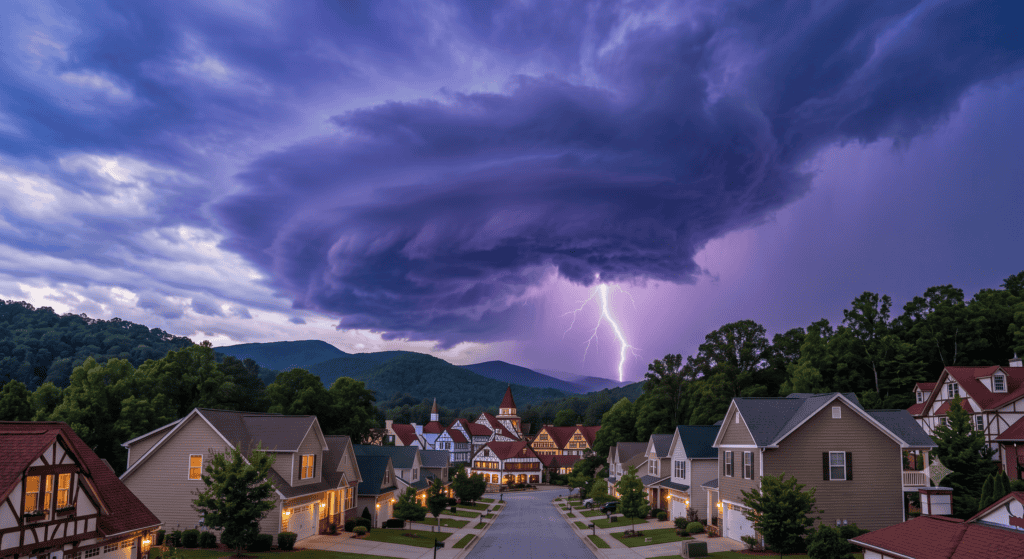
Going into 2026-27, NOAA and the independent forecasters are more confident than usual that this one lands in that top group. Which puts it in the same sentence as 1982-83, 1997-98 and 2015-16, three of the most consequential El Niño winters in the last fifty years. When the ocean runs that hot, Georgia doesn’t get some different pattern. We get the usual one with the volume cranked up: more rain, more storms, better odds on one of those ice events that snaps limbs and leaves half a county dark for three days.
Everything above still applies, in other words. There’s just more of it coming.
What all of this means for your house
For anybody who owns a house around Covington, Milledgeville, Augusta or the counties in between, a strong El Niño winter comes with a few practical consequences worth handling before the first hard freeze.
Your heat won’t run steady. It sits idle, then gets leaned on hard for three or four days, and that’s the pattern that finds a tired igniter, a capacitor on its way out, or a heat pump that can’t quite hold the house once it drops into the twenties. A tune-up finds those things on a Tuesday afternoon. An ice storm finds them at two in the morning.
Humidity turns into a January problem, which is not how anybody plans their winter. With the AC off, a soaking wet season just leaves the moisture sitting in the house, and it collects on window frames, in the crawl space, in the closet on the north wall. That’s where mold gets started.
The freeze-thaw business is hard on plumbing. Mild Thursday, 20 degrees Saturday, back to mild by Monday. It’s rarely one long freeze that splits a pipe down here. It’s the constant working back and forth on fittings out in a crawl space or a garage.
Outages get likelier, on account of the ice. Worth deciding now how you’d keep the house warm if the power quits overnight, whether that’s a generator big enough to run your furnace’s blower and controls or just a plan you’ve thought through once.
A short pre-winter checklist
Nothing exotic on this list.
Have somebody look at the furnace or heat pump now, while a worn part is still a repair on a Tuesday and not an emergency call at midnight.
Foam sleeves on any pipe you can see. Hoses off the spigots, all of them.
Make sure the thermostat, smart or the old kind, isn’t fighting you every time the weather jumps thirty degrees.
Did the house feel damp the last wet winter we had? Go price a dehumidifier while it’s still fall, because February turns out to be a rough month to go shopping for one.
And if your street goes dark every time a limb comes down, sort out backup heat before the first ice storm turns up in the ten-day.
Wrapping it up
So no, El Niño and La Niña aren’t just something the weather guy says. They’re the main reason one Georgia winter looks nothing like the one before it. La Niña buys you quiet, dry and mild. El Niño brings wet, stormy and unpredictable, with ice as the headline risk, and this year’s forecast has us in the strong-to-historic version of that across Covington, Milledgeville, Augusta and the rest of central and north Georgia.
None of which has to turn into a problem. Knowing which pattern you’re in, plus an hour spent on the heating system and whatever plumbing is hanging out in the cold, is usually the whole difference between a winter you barely notice and a repair call on the coldest night of the year.
We work Covington, Milledgeville, Augusta and the counties around them. If you want somebody to put eyes on your furnace or heat pump before this pattern really gets going, give us a call and we’ll find you a spot on the schedule.