
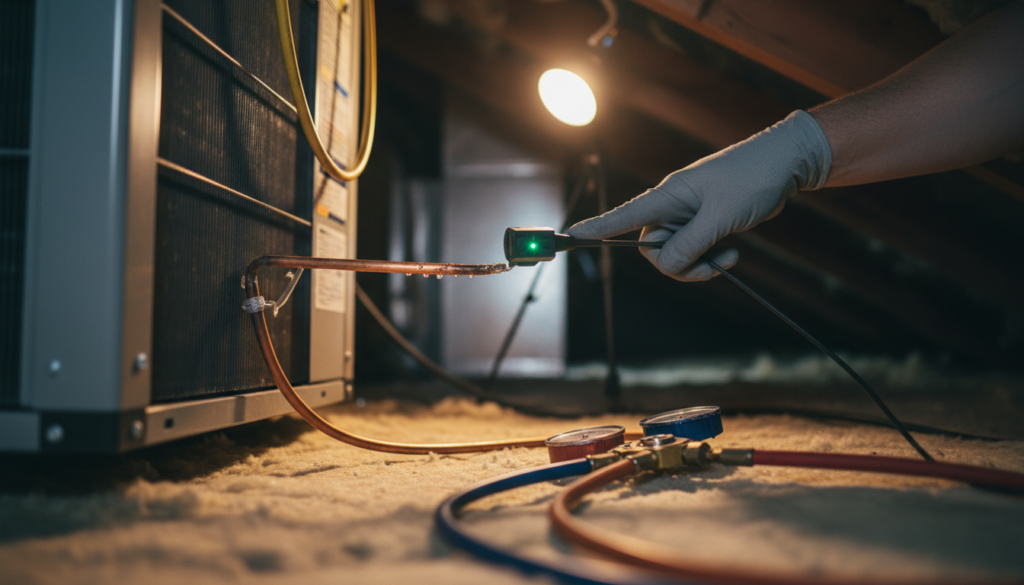
Most common freon leaks don’t announce themselves. They start as pinholes in an evaporator coil or a weeping service valve, and the system limps along for months while the compressor quietly works itself to death trying to make up for the missing charge.
The fix is almost never “add more refrigerant.” The fix is finding the hole, repairing or replacing what’s leaking, and then charging the system back to spec. Anything else is renting cold air by the month.
I’m Pat Hayes, president of Air Conditioning Specialist Inc., and we’ve been chasing leaks in middle Georgia homes since 1967. The call we get from the Byron neighborhood is almost always the same one.
“It was working fine yesterday.” And it probably was, in the sense that a tire with a slow nail in it works fine until the morning it doesn’t. A unit blowing lukewarm air in June didn’t break in June. It’s been bleeding since March, or since last fall, and it finally crossed the line where the coil can’t do its job anymore.
So this is the guide I wish more homeowners read before that phone call. Not so you can fix it yourself (you can’t, legally or practically), but so you know what your system is telling you while there’s still time to do this the cheap way.
Where Common Freon Leaks Start in Byron Homes
The evaporator coil is where most common AC problems live, and it’s the one place you’ll never see the problem with your own eyes. That coil sits inside the air handler or above the furnace, buried behind sheet metal, and the leaks it develops are frequently smaller than a pinhead.
We had a job in an older subdivision near Byron where the homeowner was absolutely convinced the unit was “just dusty.” Nice guy, sharp guy, wrong guy. The coil had developed pinhole leaks you could not see, could not hear, and could barely find with an electronic sniffer even when we knew roughly where to look. He’d been topping off that system through two summers with another outfit before anyone bothered to ask why it kept needing gas.
What causes those pinholes is where I’ll be honest about the limits of what we know. The trade calls it formicary corrosion, and the usual explanation involves chemical interactions, sometimes traced to household cleaners and off-gassing from things inside the home. We’ve read the arguments both ways and I’m not fully convinced anyone has the whole picture.
Some coils in spotless houses corrode. Some coils in houses full of candles and cleaning sprays run twenty years without a hiccup. What I can tell you from the truck, not the textbook, is that older copper develops these leaks more often than newer coil designs, and that once a coil starts pitting, it doesn’t stop.
After the coil, the usual suspects are the service valves out at the condenser, the flare fittings and braze joints on the line set, and the spots where a copper line rubs against sheet metal or a wall penetration for a decade until it wears itself thin. Every so often the leak turns out to be internal to the compressor itself, and that changes the whole conversation, because now you’re not patching a line, you’re weighing a major component against the age of the system.
Georgia humidity doesn’t help any of this; in many cases it can shave a meaningful percentage off equipment lifespan compared to drier climates. And sometimes the “leak call” isn’t even a leak. A filter that hasn’t moved since Christmas will choke airflow, ice the coil, and mimic a low charge convincingly enough to fool a homeowner and, occasionally, a lazy tech.
The rub-out leaks are my least favorite, for what it’s worth. The line set disappears into a wall on Oak Street and you’re probing insulation with a sniffer wondering who stapled it that tight in the first place.
Why Topping Off Is the Most Expensive Thing You Can Do
Repairing common freon leaks the right way means finding the leak, fixing it, pulling a vacuum, and weighing in a fresh charge. Topping off skips the first three steps, and it’s exactly like pumping up a flat tire without pulling the nail. You’ll get down the road. You’ll also be back.
We’ve seen this backfire in the most expensive way possible. A homeowner pays for refrigerant one summer, then again the next, telling himself he’s saving money by avoiding the “big repair.” Meanwhile the compressor has been running low on charge through two cooling seasons, and low charge means poor oil return and hot windings.
So the third summer the call isn’t about refrigerant anymore. It’s about a dead compressor, and now the top-off money is gone and the big repair got bigger. The refrigerant was never the asset. The compressor was.
“If a system needs refrigerant two summers in a row, you don’t have a charging problem. You have a hole. Somebody just hasn’t found it yet.”
There’s a timing piece to this that matters more every year. The industry is transitioning away from R-410A to a newer refrigerant, R-454B. And that new refrigerant was already in a supply squeeze by the middle of 2025.
What that means in plain terms: refrigerant availability and pricing are only getting less friendly, so a system that leaks is a system that keeps sending you to a market that keeps tightening. A found-and-fixed leak is a one-time problem. A tolerated leak is a subscription.

What a Proper Leak Repair Actually Involves
Refrigerant is not a DIY product. Don’t buy sealer kits online. Don’t let a buddy with gauges “shoot some in.” Handling refrigerants safely, as covered in EPA refrigerant safety guidelines, requires certification for a reason, and our techs carry EPA and NATE credentials to work on it. Sealants can gum up metering devices and turn a repairable coil into a replacement. A wrong charge can slug a compressor.
What does a proper repair actually look like? Depends entirely on where the hole is. A leaking valve core is a quick fix, the kind of thing a tech resolves in under an hour on a straightforward call.
A braze joint on an accessible line is a straightforward visit. A pitted evaporator coil usually means replacing the coil, and on an aging system we’ll sometimes tell you straight that a free replacement quote is the smarter conversation to have. As certified Carrier experts we do a lot of those swaps, but we’ll fix what’s fixable first.
The vacuum step is the one that separates a real repair from a patch job. After any repair to a refrigerant circuit, you pull the system down to a deep vacuum, hold it, and verify it holds before you ever open a refrigerant cylinder.
That step tells you whether the repair sealed and whether there’s moisture in the system. Skip it and you’re guessing. We don’t guess on refrigerant work.
You’d think after coming up on six decades of this work the top-off-forever customer would surprise me less. But it’s the same conversation every June. People will pay for the same repair four times before they’ll pay for the right one once.
The Refrigerant Changeover Nobody Is Talking About Enough
R-410A is being phased out. The replacement, R-454B, is a lower global-warming-potential refrigerant that the industry has been moving toward under EPA leak repair requirements. New equipment manufactured after January 2025 ships with R-454B. Existing R-410A systems can still be serviced with R-410A, but the supply picture for that refrigerant is tightening as production winds down and demand from the installed base stays high.
What this means for a Byron homeowner with a leaking system is pretty direct. If your unit is a 2015 R-410A system and it’s leaking, every pound of refrigerant you’re losing is coming out of a shrinking pool. Prices for R-410A have already moved significantly, and they are not moving back down. A system that loses a pound or two a season is going to cost meaningfully more to maintain in 2026 than it did in 2022, and more again in 2027.
That math changes the repair-versus-replace conversation faster than most people expect. We’re not pushing replacements to push replacements. We’re telling you what the numbers look like over a three-year horizon, and letting you decide.
The Failure Mode Most Techs Miss on the First Visit
Not every leak is in the obvious spots. The one that bites us occasionally, and I’ll admit this because it’s happened to our guys too, is a leak at a flare fitting inside the air handler cabinet itself.
The cabinet is closed, the fitting is behind insulation, and a sniffer probe at the service ports outside reads low charge but not dramatically low. The tech adds refrigerant, the system cools, the customer is happy for six weeks.
Then it’s low again.
The second visit is where somebody finally opens the cabinet and finds refrigerant oil staining the insulation around a fitting that was never quite right from the original installation. Could have been a 2009 install where the flare was cut a hair short.
Could have been a fitting that got bumped during a filter change. The point is that a thorough leak search means checking inside the cabinet, not just at the outdoor unit and along the exposed line set. We use both electronic sniffers and UV dye on stubborn cases, and the dye has found leaks that the sniffer walked right past.
I’m not going to cover every possible leak location in a residential system here because the list gets long and most of it doesn’t change what you as a homeowner should do, which is call someone with the right tools and let them work the problem systematically.
What Byron’s Older Housing Stock Does to Line Sets
A lot of homes in the Byron area were built in the 1970s and 1980s, and the line sets in those houses have been there since the first system went in. Some of them have been spliced.
Some of them run through wall cavities that have been insulated over twice since the original install. And some of them have been rubbing against something for forty-some years.
Copper work-hardens when it vibrates. A line set that’s been in contact with a joist or a wall stud and has had a compressor cycling against it for decades develops fatigue cracks in spots you’d never think to look.
We pulled a line set out of a house near downtown Byron a couple of seasons back that had a crack at a bend point inside the wall, completely invisible from either end. The only reason we found it was that the dye showed up at the exterior penetration after we pressurized the system. The line set was original to the house, which put it at well over three decades old.
In many cases, homes built before 1990 that have never had the line set inspected or replaced are worth mentioning when you call. It typically changes the scope of the leak search.
Warning Signs and When to Call
Call before the house is miserable, not after. Middle Georgia gives us genuinely hot summers, and the week the first brutal stretch hits is the worst possible week to discover your charge is low.
A leak caught in April is a scheduled visit. The same leak in July is a house at eighty-five inside and everybody sweating while we work through the emergency board (we target a two-hour response on true emergencies, but April-you never needs to test that).
Here’s what to watch for, including other signs your AC is low on refrigerant that often go unnoticed until the damage is done:
Ice on the copper lines near the outdoor unit or at the attic air handler. Ice in a Georgia summer is never a good sign. Shut the system off and call. A hissing or bubbling sound when the unit shuts down. Classic symptom. Refrigerant moving through a restriction or escaping a small opening makes exactly that noise. Bills creeping up with no change in your thermostat habits. Lost charge means lost efficiency, and the power company collects the difference before you ever feel warm air. Longer and longer run times. The system that used to satisfy the thermostat by supper now runs past bedtime. This one sneaks up on people because it happens gradually, and honestly it’s the symptom I’d trust most. Lukewarm supply air at the vents even though everything sounds normal.
Can’t a tune-up catch this before any of those signs show up? Usually, yes. A tech with gauges and a sniffer on the system in spring finds low charge and small leaks long before they cost you a compressor, which is most of the argument for our seasonal maintenance plans in the first place.
And while I’m on spring: every March the pollen coats everything out here. Your truck is yellow, your dog is yellow, and your condenser coil is trying to reject heat through what amounts to a pollen sweater. That’s not a leak, but it stresses the same components a leak stresses, and the two problems together will find your system’s weak spot fast.
We can typically get eyes on a suspected leak with a same-day appointment during the shoulder seasons. In July, everybody’s calling.
One Thing That Looks Like a Leak But Isn’t
Byron’s older housing stock adds one wrinkle worth mentioning: a lot of these homes have had attic ductwork patched two or three times by two or three different hands, and previous “repairs” sometimes hide the very line sections we need to inspect. If you know your attic has history, say so up front. It changes where we look first.
The other thing that mimics a refrigerant problem is a failing metering device. A TXV (thermostatic expansion valve) that’s hunting or stuck closed will produce symptoms that look almost identical to a low charge: long run times, warm supply air, sometimes ice on the suction line.
The difference shows up on the gauges if the tech knows what to look for, but a tech who goes straight to “must be low on refrigerant” without checking superheat and subcooling numbers can add refrigerant to a properly charged system and make it worse. We’ve cleaned up that mistake more than once on a second-opinion call, and it’s exactly the kind of thing covered in AC problems that need professional repairs rather than a quick field guess.
The gauges tell the story. The refrigerant quantity is just one chapter of it.
If Something Sounds Off, Call
Look, if something sounds off, or you’re seeing frost on a line, or the unit just seems to run and run, that’s enough reason to have our AC repair team put gauges on it. It doesn’t have to be a breakdown to be worth a call.
Air Conditioning Specialist Inc. runs out of Milledgeville and Covington, Georgia, and we cover the Byron area regularly.
If your system needed refrigerant last summer, that gas went somewhere, and it’ll go somewhere again this year. Call (844) 256-6800 and tell us what you’re hearing, and we’ll schedule a proper leak search on the system before the real humidity sets in.
By the Air Conditioning Specialist Inc. Team
Frequently Asked Questions
How do I know if my AC has a refrigerant leak or just needs a filter change?
A clogged filter and a refrigerant leak can produce nearly identical symptoms, including warm air from the vents and ice on the indoor coil, so the two are frequently confused. The clearest early indicator of a refrigerant issue is a pattern of declining performance across multiple seasons, not a single episode. A dirty filter causes problems that fully resolve once the filter is replaced. A refrigerant leak causes problems that return because the underlying hole in the system is still there. A certified technician can confirm which condition is present by measuring system pressures and airflow in the same visit.
What is formicary corrosion and why does it cause AC coils to leak?
Formicary corrosion is a specific type of pitting that forms inside copper evaporator coil tubing, producing pinholes small enough to be invisible to the naked eye and difficult to detect even with electronic leak detection equipment. The corrosion results from a chemical reaction involving formic or acetic acid, moisture, and copper, and those acids can originate from household cleaners, building materials, or off-gassing inside the home. However, the correlation between household chemistry and coil failure is inconsistent in practice: some coils in chemically active environments last decades, while others in clean homes develop leaks early. Once pitting begins in a copper coil, the process continues and additional leak sites typically develop over time.
Can a refrigerant leak in a central AC system be repaired, or does the whole coil need to be replaced?
Whether a leaking coil can be repaired or must be replaced depends primarily on the location and severity of the leak, and the age of the equipment. A single accessible braze joint or flare fitting leak can often be repaired directly. Formicary corrosion that has produced multiple pinholes across an evaporator coil surface is generally not repairable in the field, because sealing one site does not stop corrosion at others, and chemical sealants added to the refrigerant circuit can damage metering devices and void manufacturer warranties. For coils showing widespread pitting, replacement is the more reliable long-term solution.
Will low refrigerant damage my AC compressor even if the system is still blowing some cold air?
Yes, running an air conditioner with a low refrigerant charge damages the compressor even when the system is still producing partial cooling. Refrigerant carries lubricating oil throughout the system, and a low charge reduces oil return to the compressor. It also causes the compressor to run hotter than its design tolerances. Both conditions accelerate wear on the compressor windings and internal components. Because a slow leak can take months to reach a point where comfort is noticeably affected, a compressor may sustain significant wear before a homeowner realizes anything is wrong, which is why repeated refrigerant top-offs without leak repair often precede early compressor failure.